First Pipe in the Ground!
There has been a lot of activity in Phase 7 the past two weeks! The pond continues to be dug, first stormwater pipe is being installed, the sewer wet well digging has begun, and lot corners are being staked by surveyors. You may start to see some signs of street locations as well. With all of the digging, the dirt has to go somewhere, so much of it is distributed around the site in places where it can begin to dry out and potentially be used as the project moves forward for base material. Some of where it is being spread is where roads will eventually be cut in. It is also being used to begin filling in the old farm ditches that criss cross the site.
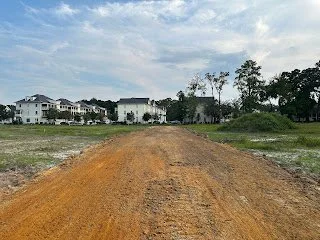
Dirt from the pond being spread where a road will eventually be cut in.
You can see the pond is gradually getting bigger. It looks like the engineers did a good job in their design as the depth is right at where groundwater is just beginning to come in.
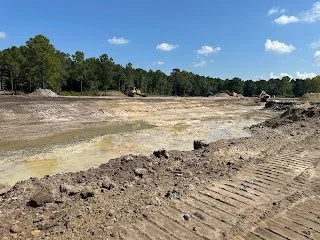
The pond has gotten much larger with the whole north bank almost cut in. The bottom of the pond is right at the water table, which is why there is a little bit of water at the bottom.
Storm drain boxes and pipe started to get delivered. You may remember a previous post that showed the careful attention to the design of each one of those boxes. Now, you can see what those look like. They’ll each have concrete tops placed on top that will hold the iron grates, which will eventually be all you will see from above ground. As you can probably guess, the large holes are where the concrete pipes get inserted and mortared into place. The smaller holes towards the top are for French drain pipes extending out from the boxes to help keep the ground dry around road bases.
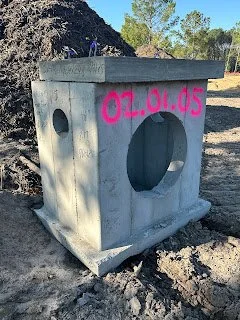
Storm Drain Box with large hole for concrete storm pipe and small hole for French drain. Concrete lid sitting on top.
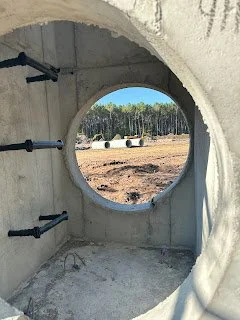
Looking through one of the storm drain boxes.
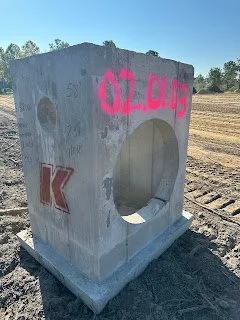
Another example of one of the storm drain boxes that will be put in. Each one will have an iron grate on top, which is what you would see above ground.
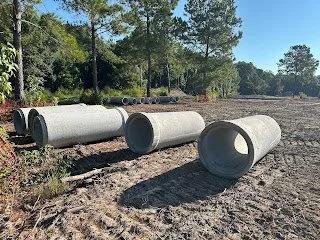
Some of the concrete pipes that will be used to transport stormwater runoff to the ponds.
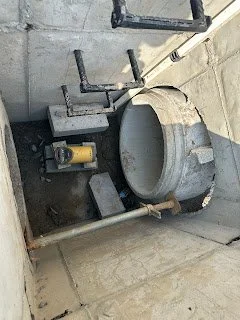
An example of a pipe that has been inserted into a box but not mortared yet. Each pipe has to be set at an exact slope so that it will connect into the next box at the right height (and because water runs downhill!)
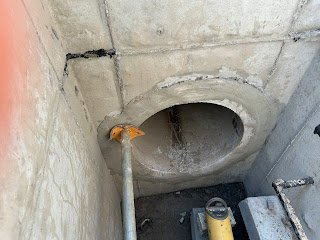
Here’s the other side of that box where the pipe has been mortared in.
Typically, most pipe laying will start with the deepest and work its way back. So, much of the first storm drain pipes that will be going in first will be the ones that empty into the ponds. These are the outlet pipes. They will work back from there in most cases. You can see the first outlet that was put in last week.
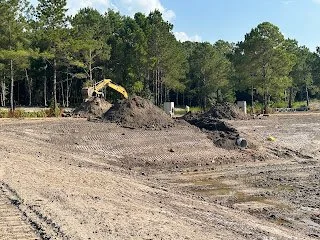
This shows the outlet pipe exiting into the pond. Once the pond is full, the pipe will be underwater. The contractor starts with the outlet pipe and works their way backwards from there when laying the pipe.
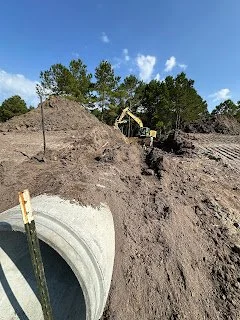
Outlet pipe looking back to where the contractor is digging to set the first box.
The sewer pump station site was staked out and the digging has begun for the wet well. If you are unfamiliar with pump stations, you can find 4 pump stations in Habersham. One is behind a fence on your left just before you get to the car gate going to the pool. Does anyone know where the other 3 are? If so, put your answer in the comments. For those unfamiliar with pump stations, here is a short video found on YouTube that gives a simple explanation of what they are and how they work:
Basically, gravity is used to get all sewer to this point. It all drains into the pump station’s wet well, which is essentially a tank. Because it is fed by gravity and we get no help from topography in the Lowcountry, it has to be pretty deep! This particular one will be 27’ deep!! Digging a hole with a bottom that is 7’ below sea level presents challenges and we can show that process in a future post. For now, the contractor has dug a hole down to the water table, which is 8’-10’ deep. The schedule for digging the rest and setting the wet well in (with a crane) will depend on the weather and how much water they run into down deeper. By the way, the existing pond next to this location was drained dry to help with this. Because of it’s proximity, digging a deep hole will cause the water in the pond to travel laterally underground to the deeper hole because the groundwater will be sucked into the hole, causing the pond water to infiltrate into the soil more and then into the hole itself. Draining the pond helps minimize the amount of water that has to be dealt with while digging. More to come on that!
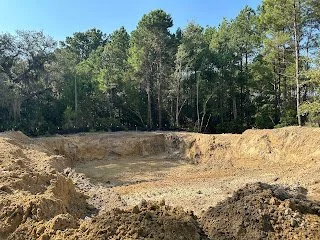
Pump Station location. The hole has been prepped and the first 10’ dug out. Although the Wet Well will only be 5’-6’ wide, the hole starts out 40’x40’ because of how deep it will end up having to be.