
Make Hay While the Sun Shines
That is what you have been seeing. Rain is finally in the forecast this weekend, but the last few weeks of no rain could not have been any better for getting roads cut in and base prepared. The contractor told me the other week, “the faucet will turn on eventually, and when it does, it usually doesn’t stop.” It has been all hands on deck to get as much done as possible while the sun shines. Not only roads, but also finishing out all stormwater infrastructure, getting dry utilities (power and telecommunications) in, finishing up the forcemain connection, getting curbs in, and grading out the rest of the site. I haven’t had a chance to get a blog post out due to just barely hanging on trying to keep up and stay ahead of everything so that our responsibilities didn’t hold up any of the work. I’ll try to cover everything that has been happening with pictures below.
Maybe the most obvious work that happened was the tying in of the forcemain (i.e., sewer line) because of the road closure it caused on Cherokee Farms Road. We realize that was an inconvenience for one day for many people, but we appreciate everyone’s patience and cooperation with it. You may remember in a previous post about the installation of the forcemain pipe from the pump station wet well all along Cherokee Farms Road down to the church and how many utilities they had to work around. That was extremely difficult and time consuming and it didn’t get any easier when it was time to cross the road and connect in to the main sewer line that takes everything to the treatment facility. BJWSA requires a manhole be installed just before the pipe ties in because it houses the check valve which keeps the wastewater in the main line from being pushed back into the project’s forcemain and they want to have access to it. Since the sewer main line is just off the shoulder of Cherokee Farms Road, this did not leave a lot of room for a manhole structure. What also made it difficult is that the main gas line is also in this location. Nobody knew if the manhole would fit in between the gas line and the main sewer line until the hole was dug, so it was a big of a crossed fingers situation.
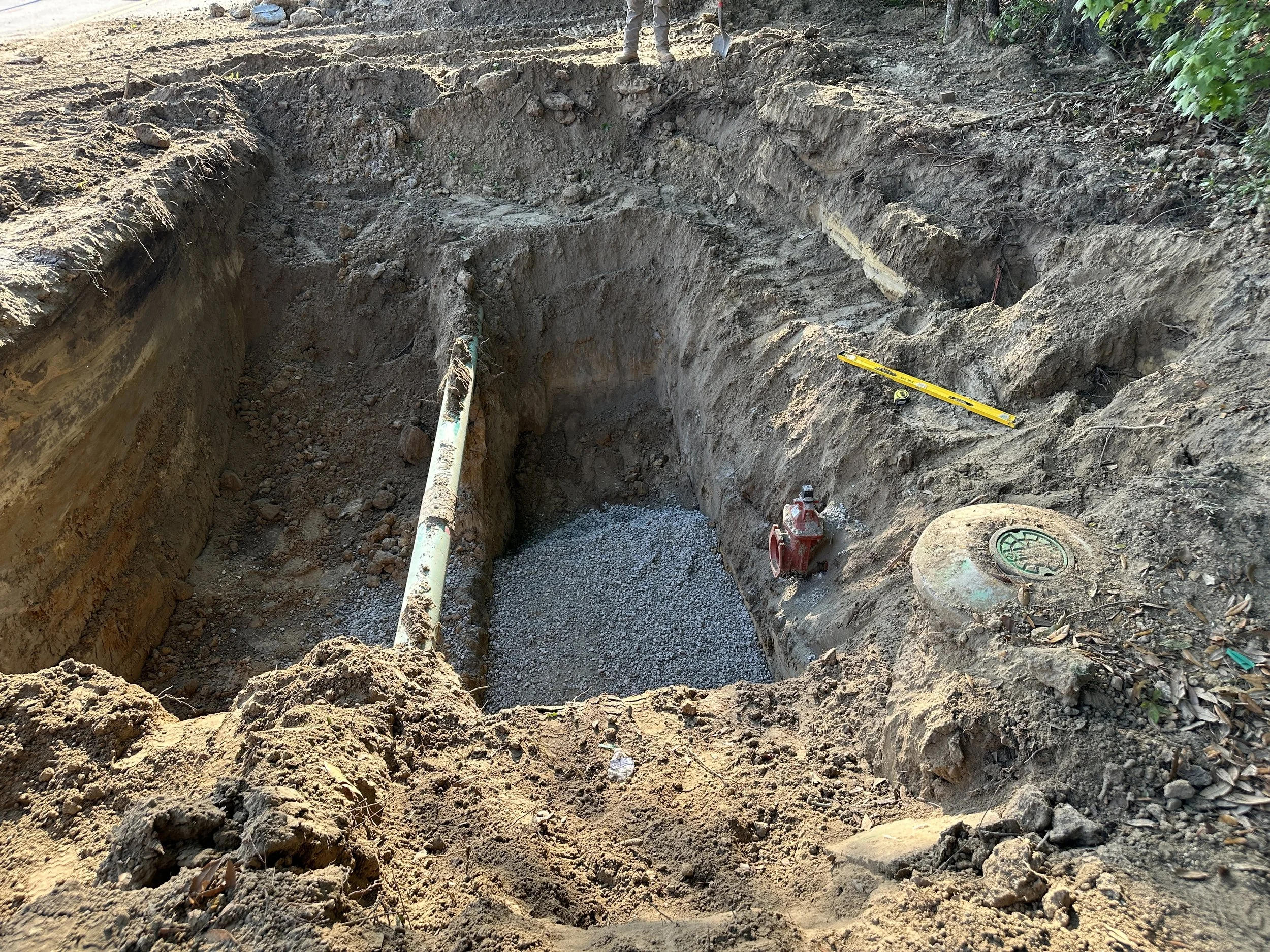
Here you can see the red valve sticking out that is attached to the tapping saddle (remember the saddle from the water tap? Same thing for the sewer tap) and the gas line passing through on the left. The manhole has to fit in between those two. Yikes!
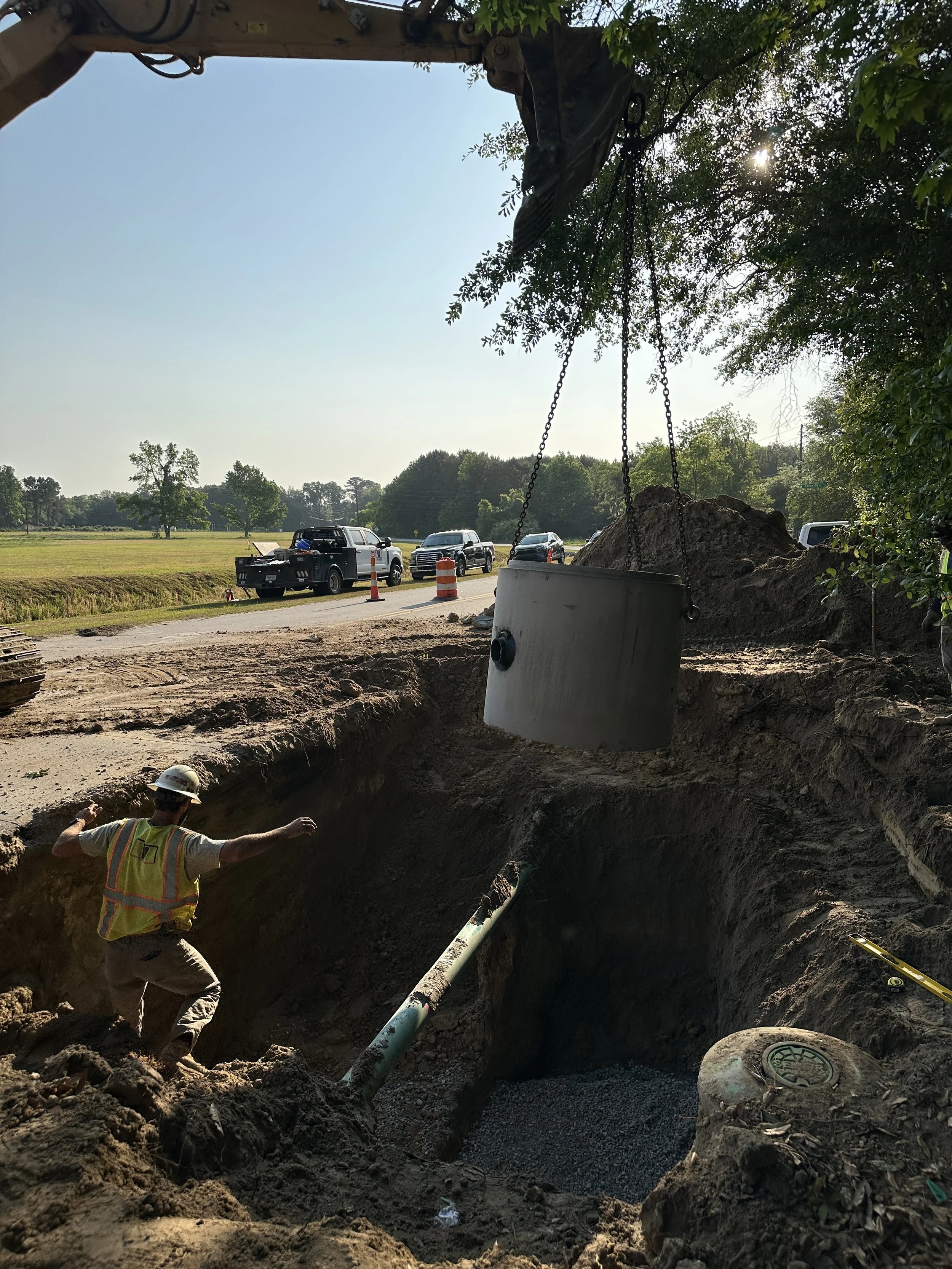
So here comes the bottom section of the manhole. Do you think it is going to fit??
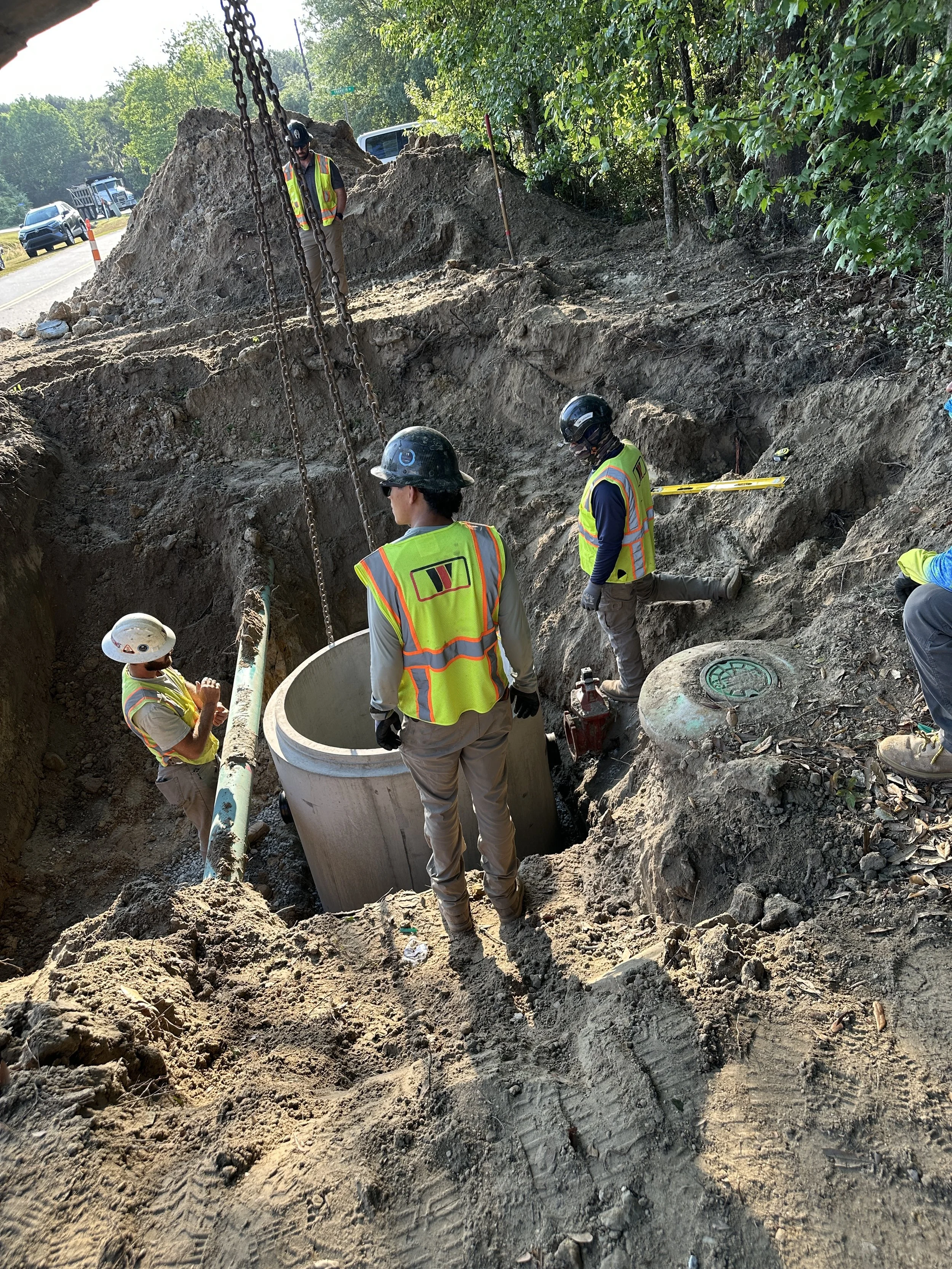
Look at that! Just by a few inches! It worked out and the gas pipe also ended up not being in the way of the pipe coming out of the manhole and the second valve that has to come up just before the manhole. My apologies for not having picture of everything in after this as I had to run to another location on site and by the time I had gotten back, they had finished and got it covered up.
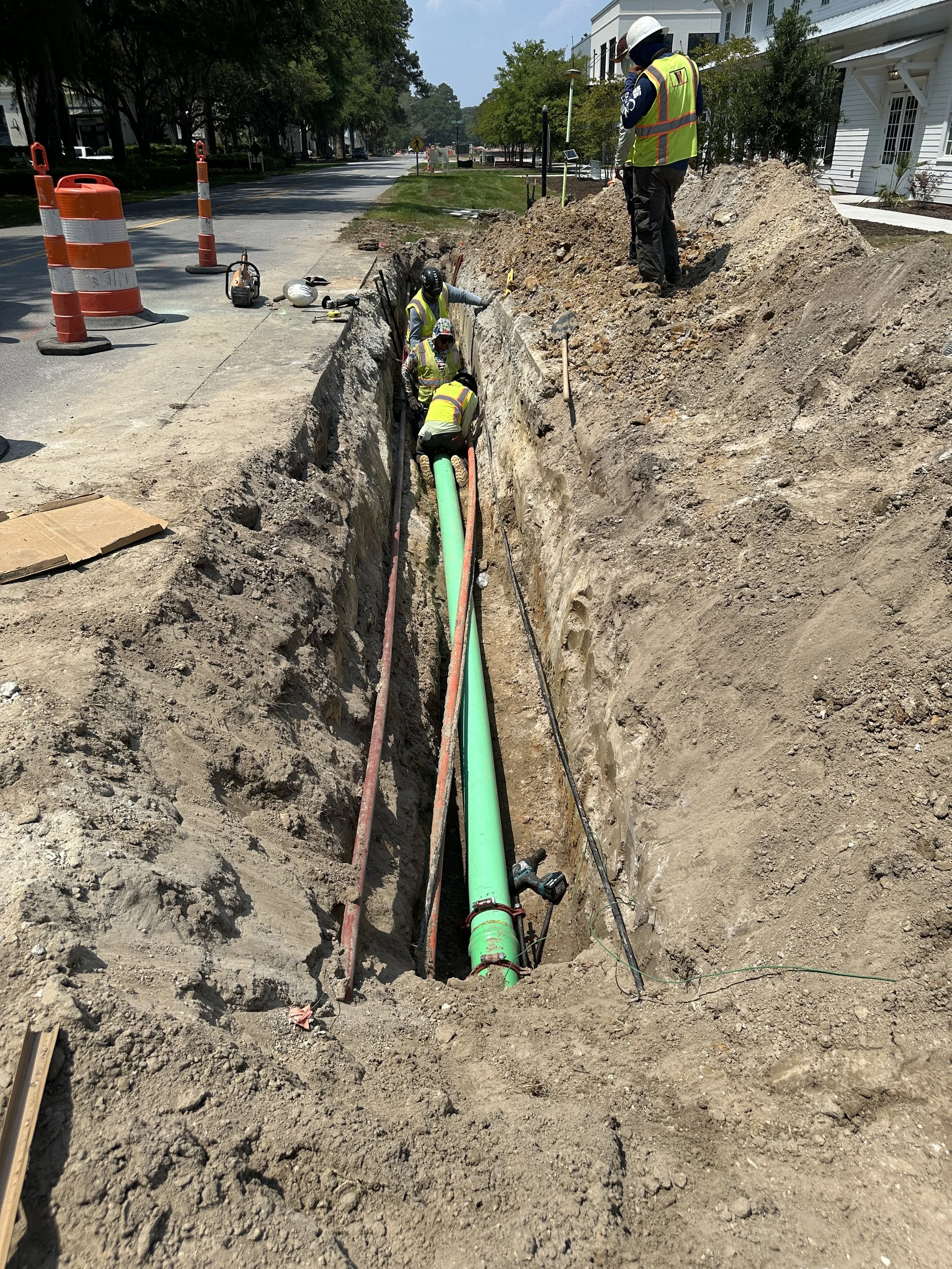
Once they got across the road, it was back to spaghetti junction of telecommunication cables to try to get the pipe in and connected to where they had left off. Everything got connected and the forcemain is now complete. These guys work so hard and it really is amazing how well they all work together to get a job done. It’s something I wish everyone could see firsthand.
Back over on the other side of the project, a second grading crew was brought in to help move dirt and get roads cut in. They finished out the grading of the dry ponds and got in all of the French Drain systems in those, most of which was done at the time of the last update. For the roads, it is all about the dirt. You’ve got to cut out everything all the way down to where you will be putting your rock base and see what you’re dealing with. The roads have been dug up so much with all of the utilities that are in them, so the contractor knew there were probably going to be areas that needed some stabilization. They typically like to cut the roads in and then have equipment running over them for a bit to help see where the worse spots are. If your base dirt isn’t compacting, you have to dig it out and put good dirt back in there. This can get very expensive because you most likely would be trucking that dirt in. Again, this is why dry weather is ideal for this work because it is difficult to get wet, muddy dirt to compact. The way you test the compaction is by what is called a proof roll, which taking a fully loaded dump truck and running it up and down the road bed to hopefully see that the tires are not pushing into the dirt any. We’ll show this further in the blog post.
Another option for non-compacting dirt (or wet dirt) besides digging it out is to mix cement into it. This is called a soil cement mix. The cement absorbs the moisture in the dirt as it is mixed in and then hardens and creates a very hard base. More and more folks are doing this now because good fill dirt is harder and harder to get at a reasonable price. It is my understanding (could be wrong) that Beaufort County is not issuing any dirt mining permits, so the dirt ends up having to be trucked in from much farther out, which increases the cost. The soil cement mix uses the dirt that is already there. It’s still not cheap because it requires special equipment, which you’ll see in the pictures and you have to buy the cement.
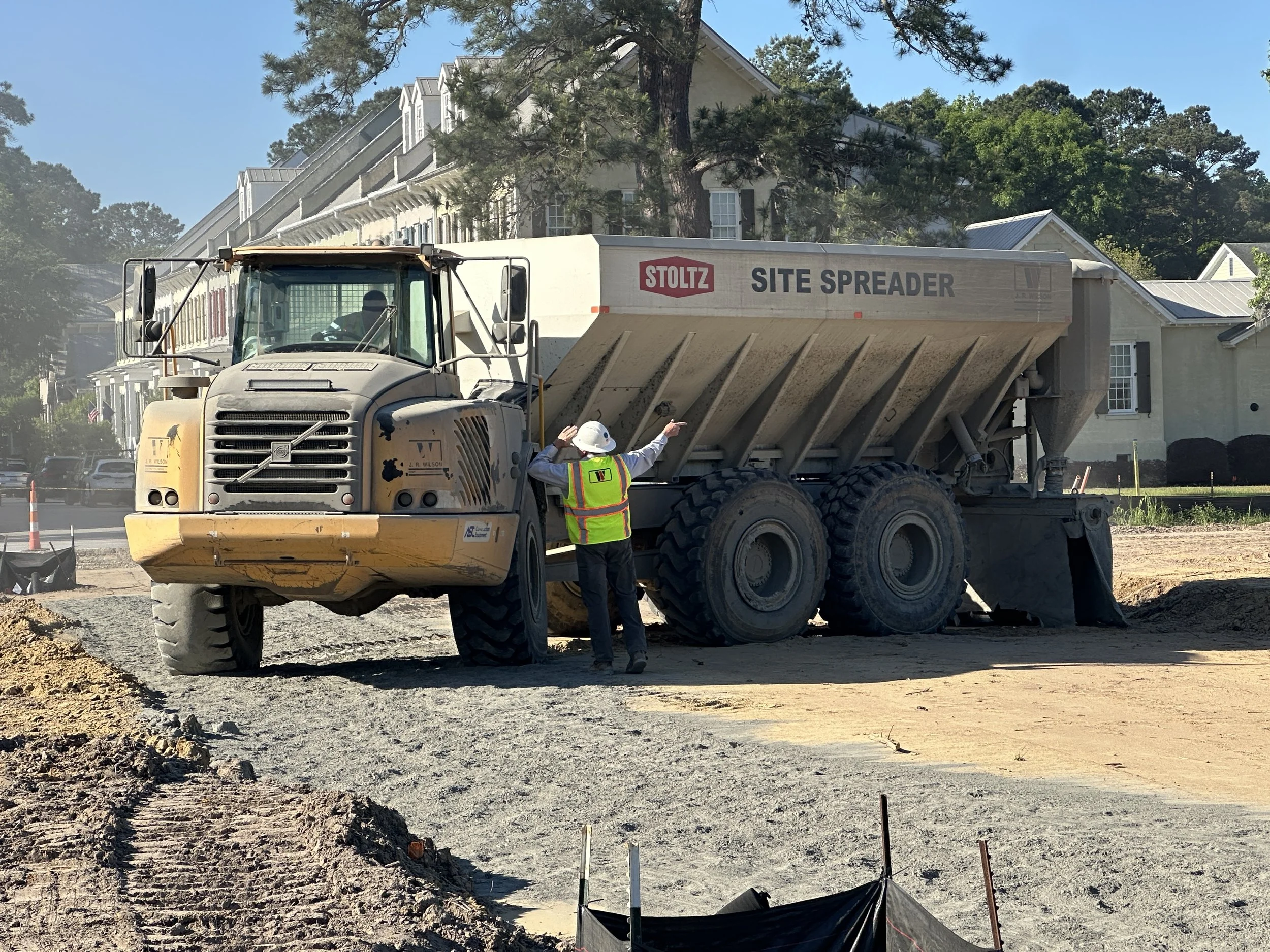
This is the cement spreader truck. Once the road bed is cut out, this truck comes through and spreads a certain amount of cement on the road. You can see in the picture where the truck has made one pass and the rest of the road is still bare. This is Mr. Wilson telling his operator where to go next. The amount of cement is determined by the condition of the soil. For instance, this used around 30 lbs of cement per square yard of road. If you were trying to get compaction through pure muck, you may use over 100 lbs. per square yard. The dirt here is pretty good, it’s just been churned up so much with all the digging, so needed a little bit of help.
This is the spreader in action, putting the prescribed amount of cement on the road.
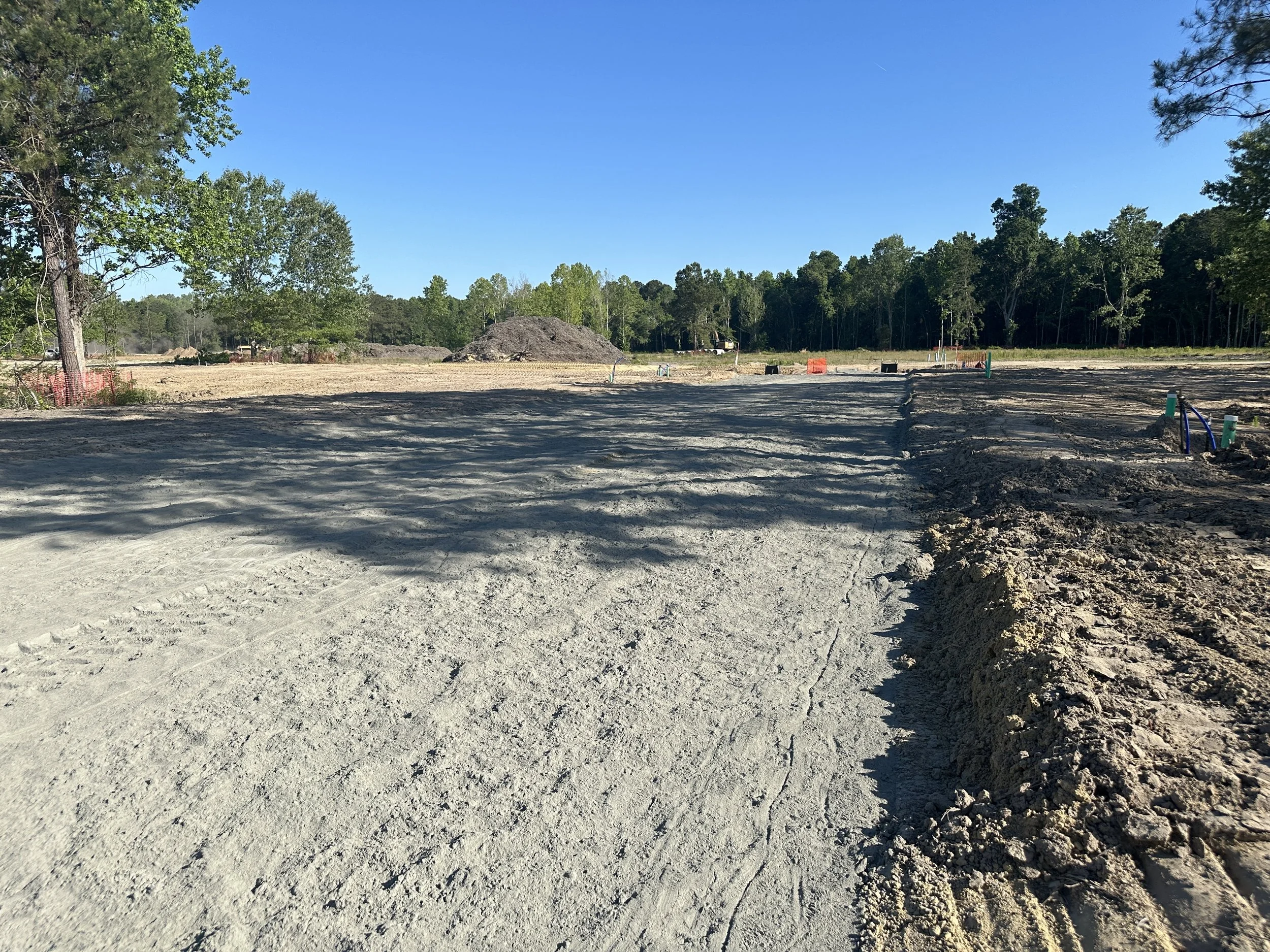
This is the road once all the cement has been spread across it.
Next, the mixing machine comes in to mix all of that cement into the soil. This is a heck of a piece of equipment. Underneath it is a big drum with teeth that can be lowered into the ground to the depth needed and basically till the road bed up with the cement. In our case, they were going down about 15”-16”. Looks like it could go as much as 2’!
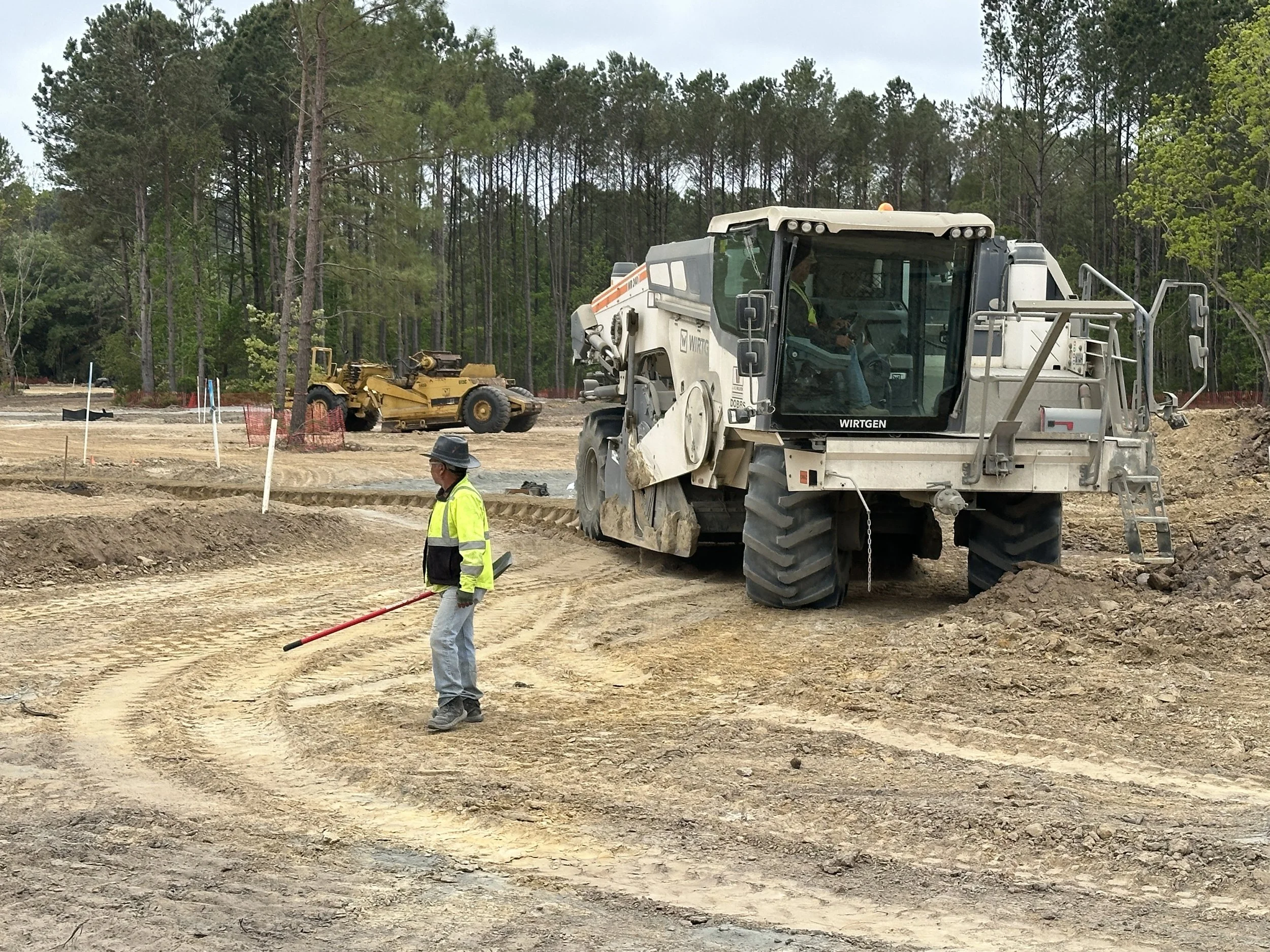
This is the machine that does the mixing.
Here, you can see it at work. Towards the end of the video, you can see the arm raising up, where he is lifting the mixer out of the ground. The guy in front guides the driver around structures in the ground because this thing seemingly grinds through anything! The driver of the machine has been working with J.R. Wilson for 2 years and he was brought in from North Carolina specifically for his expertise in soil cement. He has worked with it for years and is supposedly one of the best there is out there.
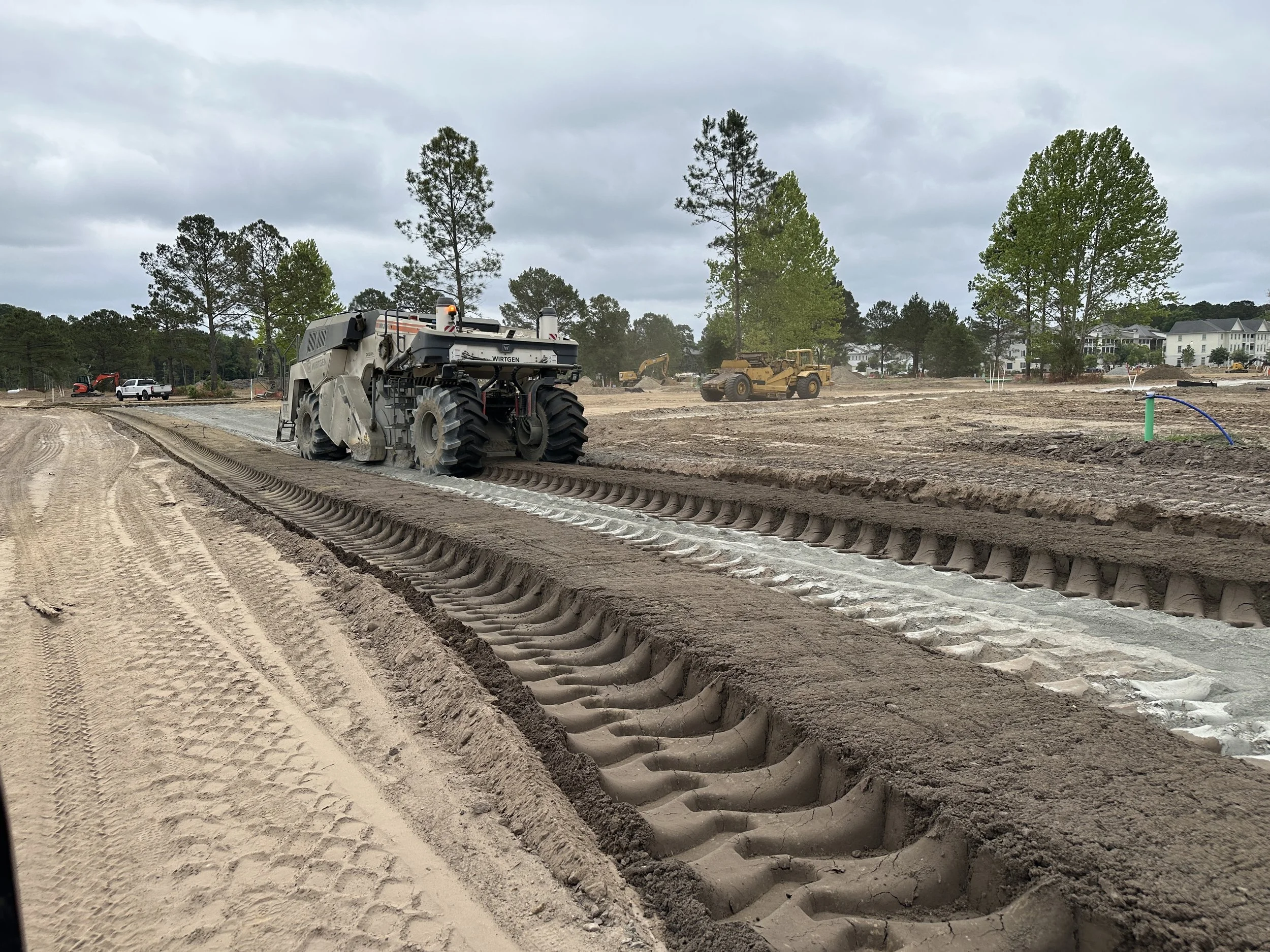
This is what it leaves in its path. The darker brown dirt is what has been brought up and mixed with the cement. It’ll all be graded back out afterwords and then set up to harden.
The next step is proof rolling. For proof rolling, a geotechnical engineer comes on site to witness the proof rolling and gives the thumbs up or thumbs down on whether the base meets the compaction requirement. He walks along the side of the loaded dump truck all the way down each road and then back, watching the tires the whole time.
The inspector is wanting to see that the tires of the dump trunk are not pushing into the dirt more than about 1/2”, which is sometimes referred to as “pumping.” Here you can see the road base is rock hard. This dump truck weighs over 40,000 lbs.!
Here is an example of where there is pumping. You see as the dump truck goes over, the ground goes down and then comes back up. This is an area that required digging out again and either mixing a higher ratio of cement or backfilled with rock. There may have been two areas like this and that was all. The inspector gave the contractor a big thumbs up and said the roads were in perfect condition. Kudos to J.R. Wilson. They will test more roads as they get them ready.
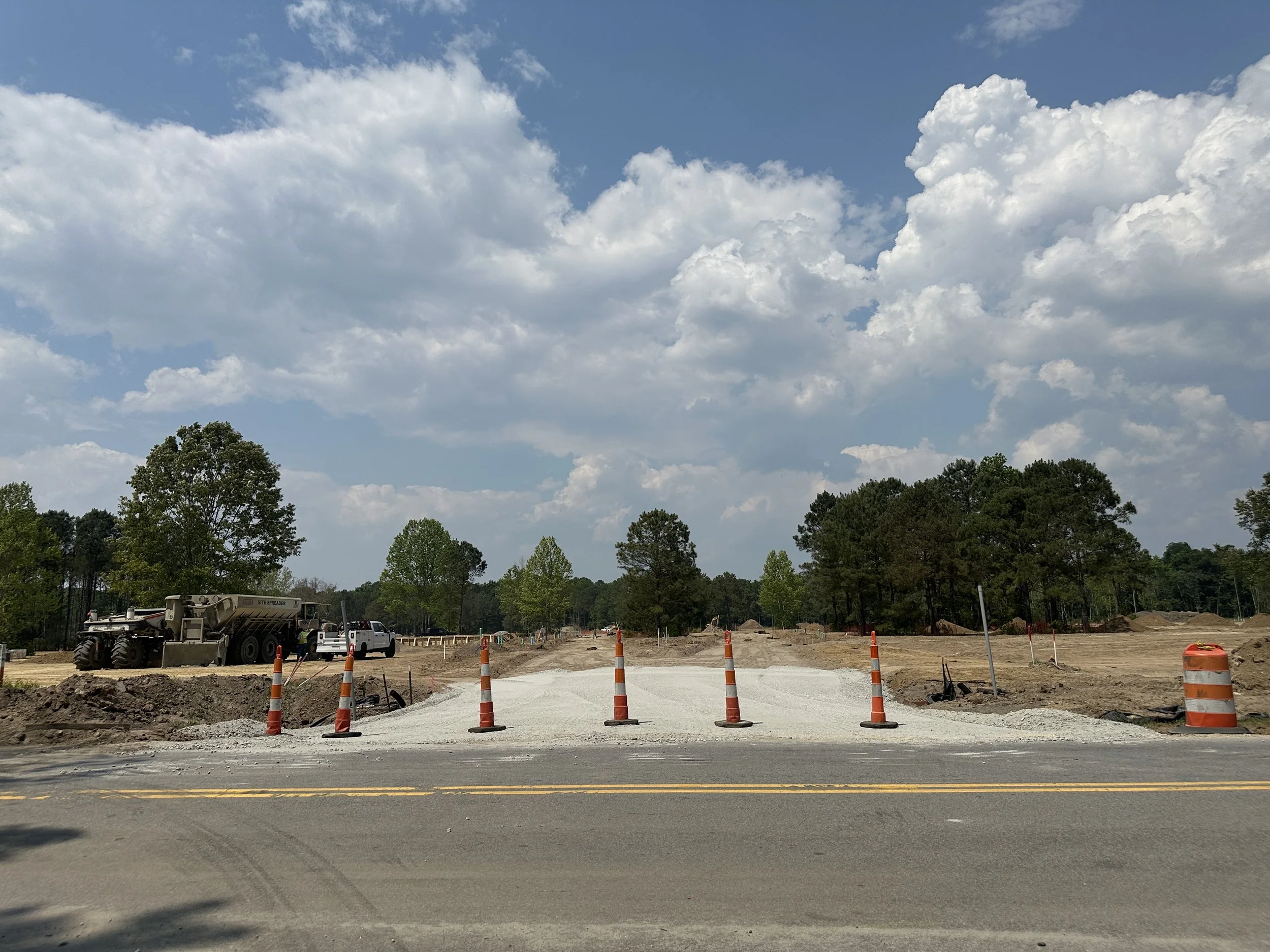
And here we go. Rock is starting to go down on those roads that have passed the proof rolling test.
Curbing is the other thing that needs to go in before rock is put on roads. Not all the roads have curb in this phase, but some of the more urban ones do. Habersham uses a vertical curb rather than a rolled curb that you see in a lot of suburban neighborhoods. The vertical curb is the more traditional curb that you see in urban areas and historic neighborhoods.
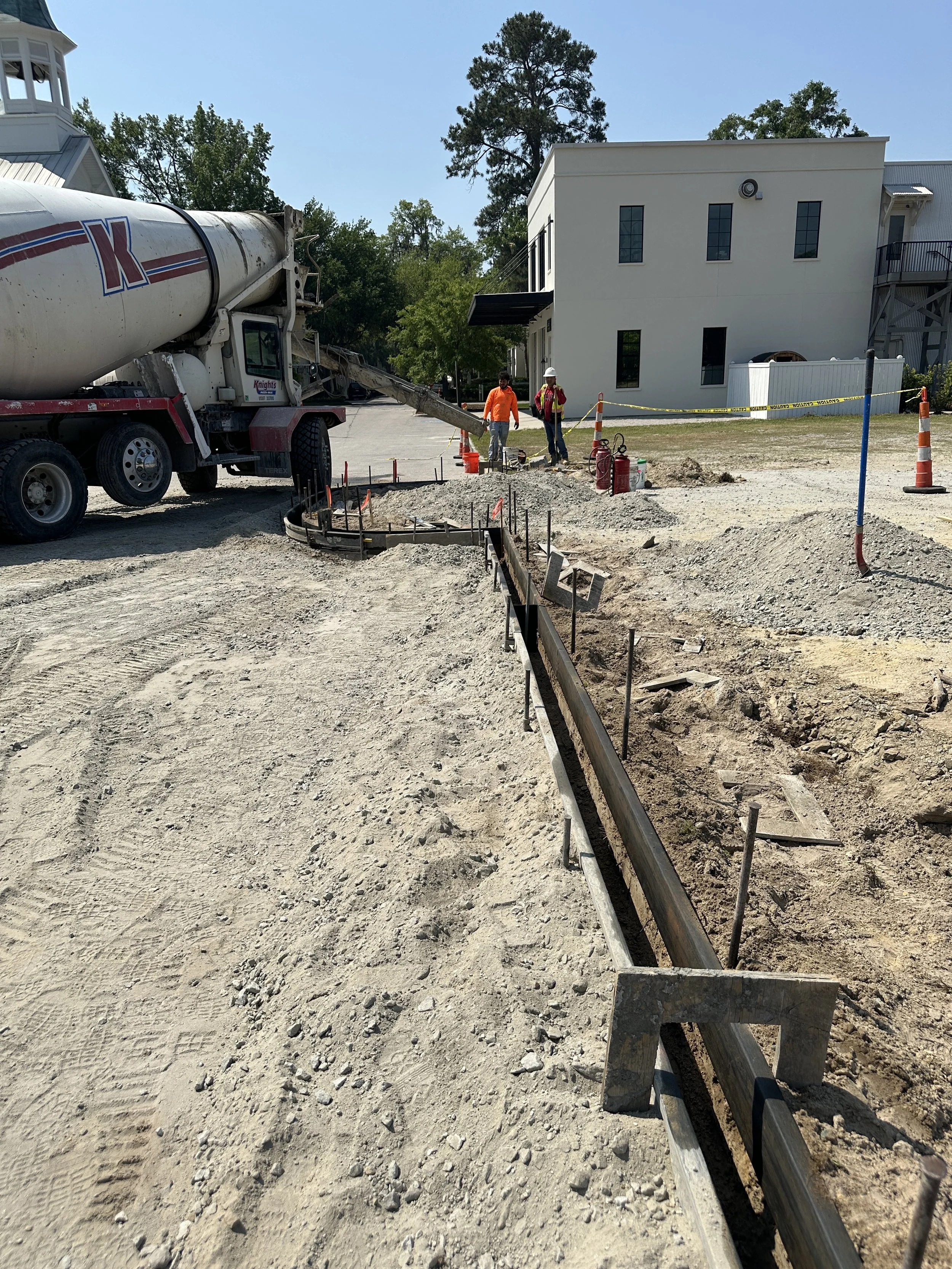
The curb being formed up for the extension of North Market.
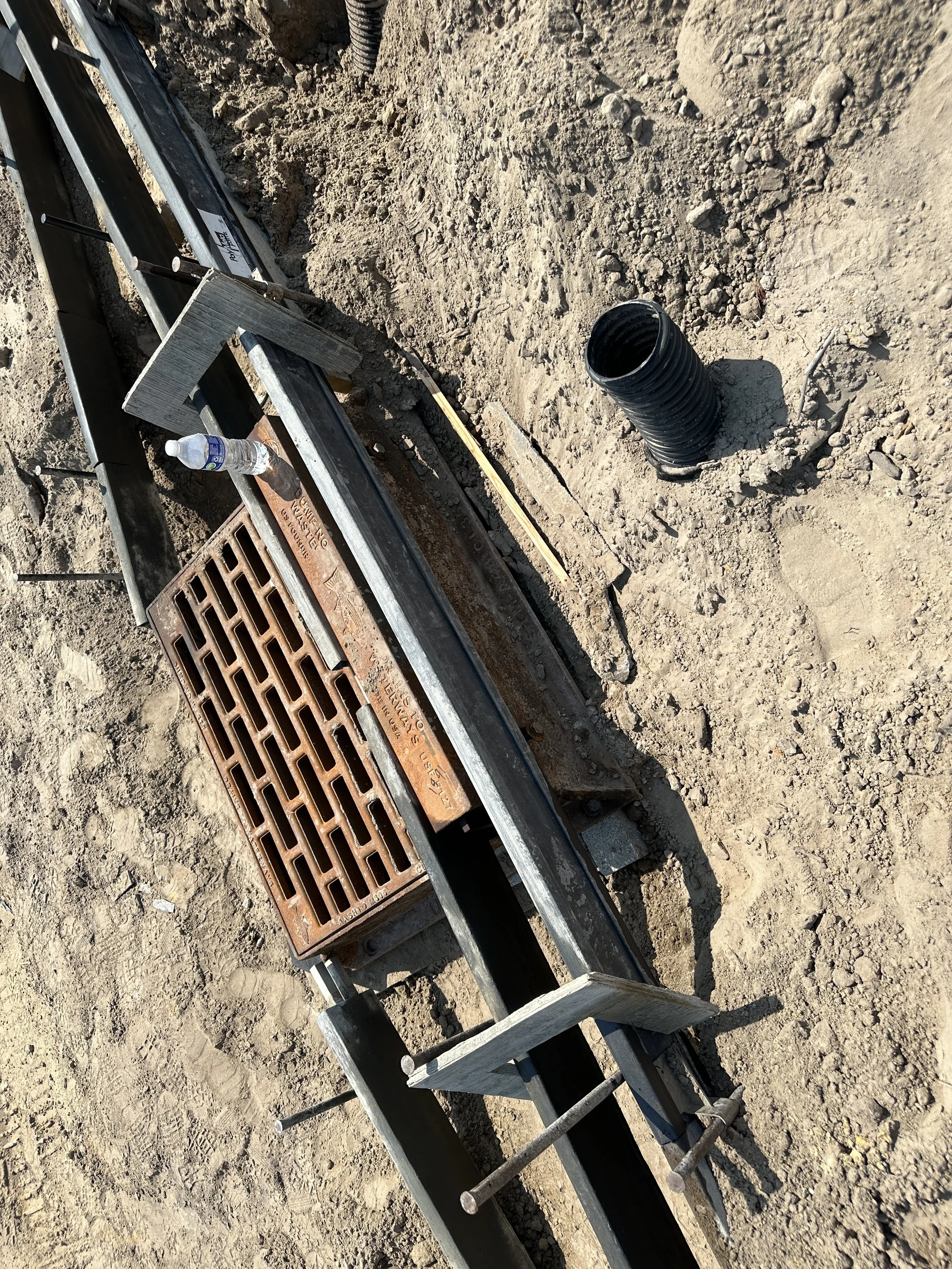
They form the curb inlets into the curb so they are integrated.
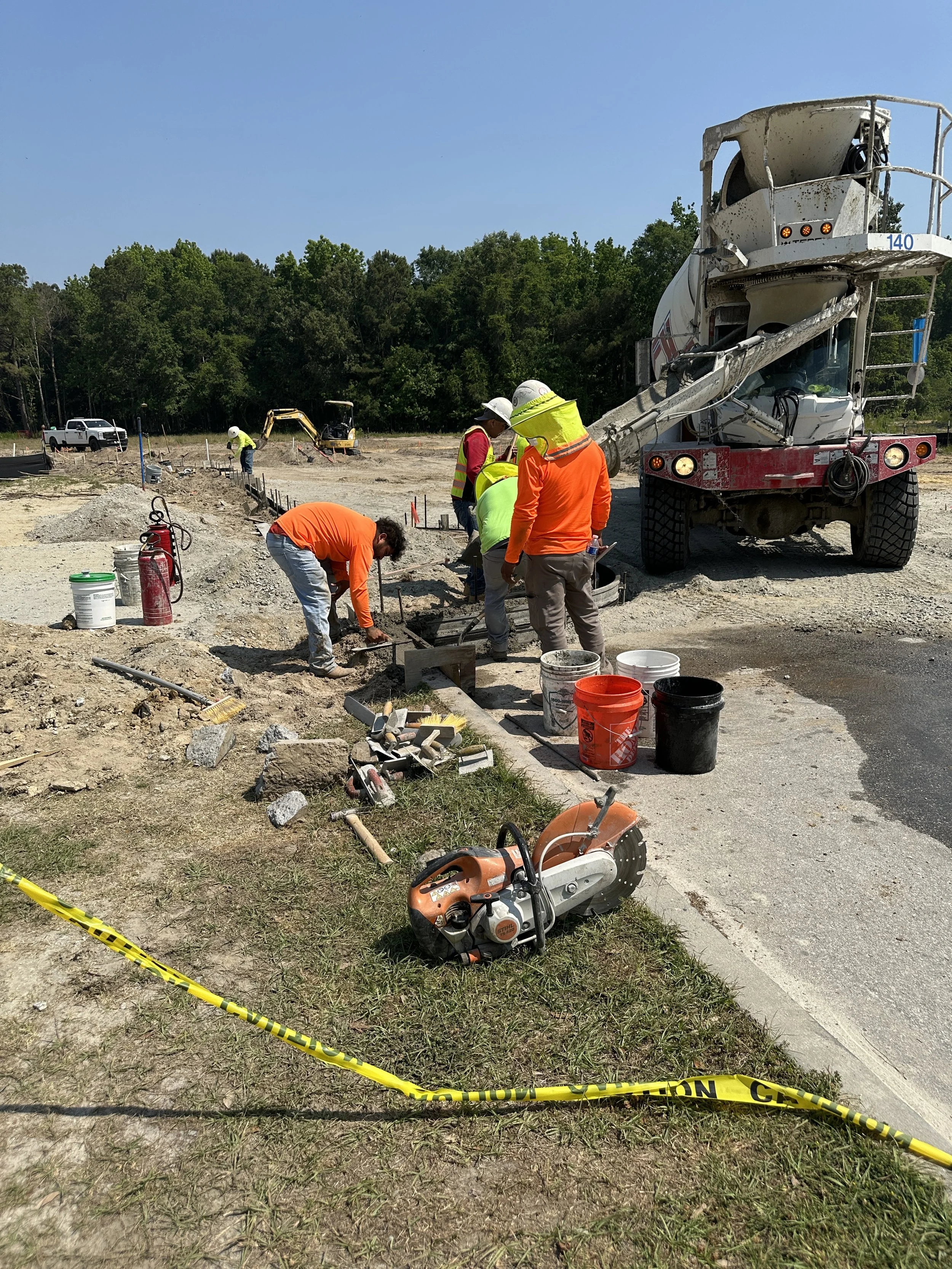
These curbs are hand formed and then hand troweled. Here, you can see the cement truck pouring into the forms and the guys coming behind it to smooth it out and give it the proper radius.
Below are a few more pictures of things happening around the site.
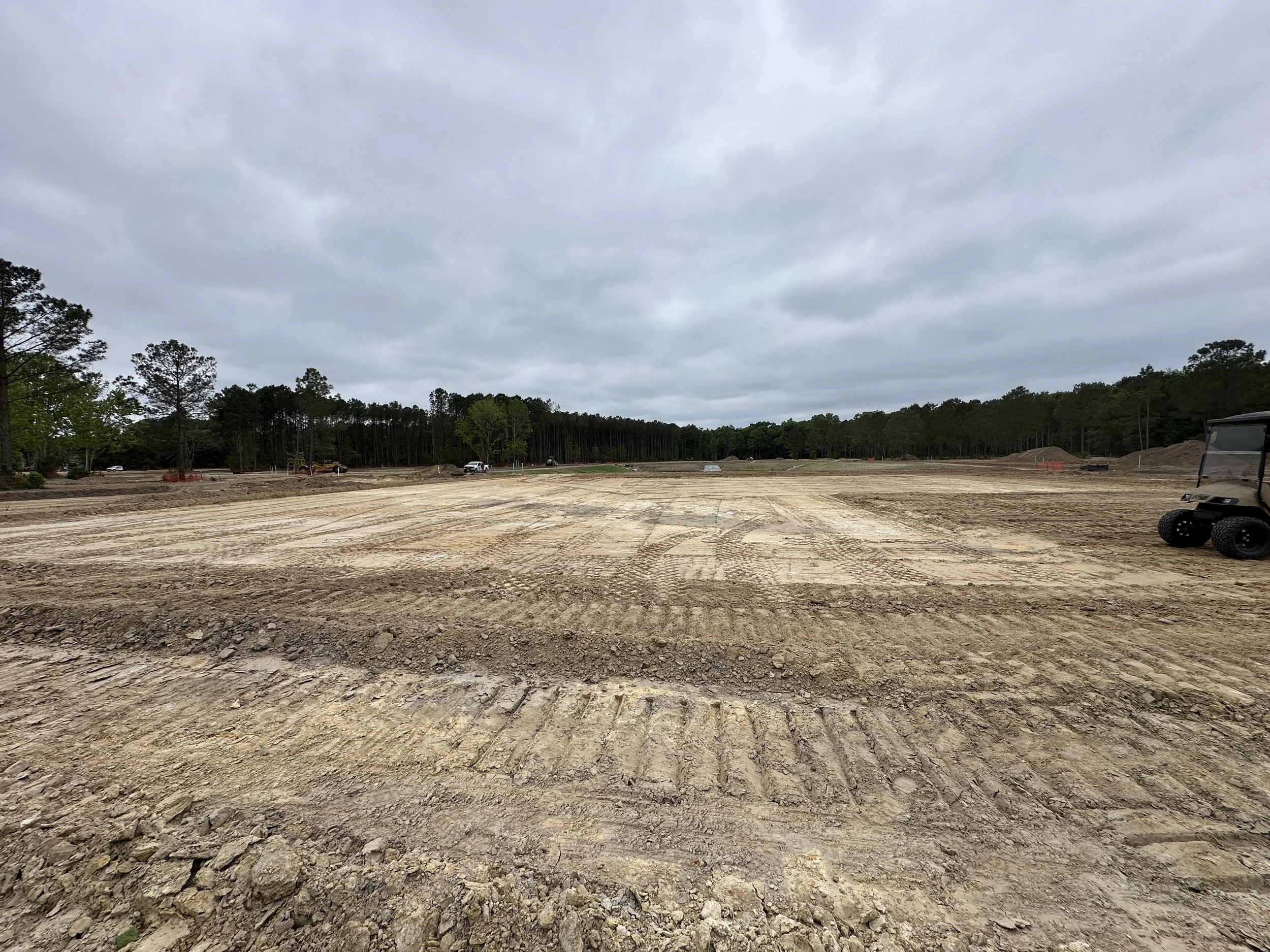
The pool site is graded and prepared. The pool deck area has to be graded down to 12” below where it will be finished so they can get the plumbing in and then pour the 6” deck on top. Still not quite ready to start but getting closer.
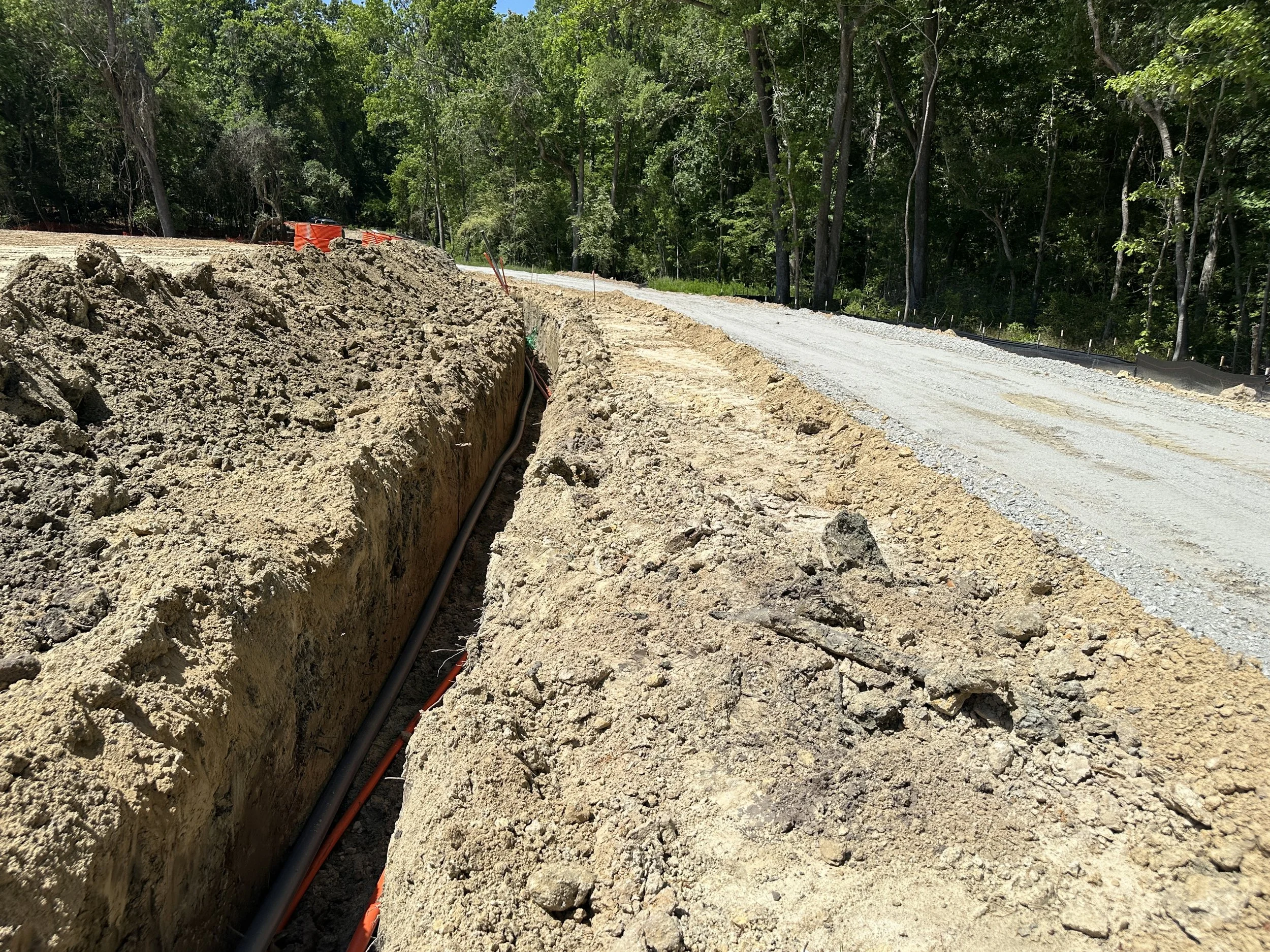
Electrical and Telecommunication conduit has started. The gray is for power and the orange ones are for Brightspeed and Sparklight.
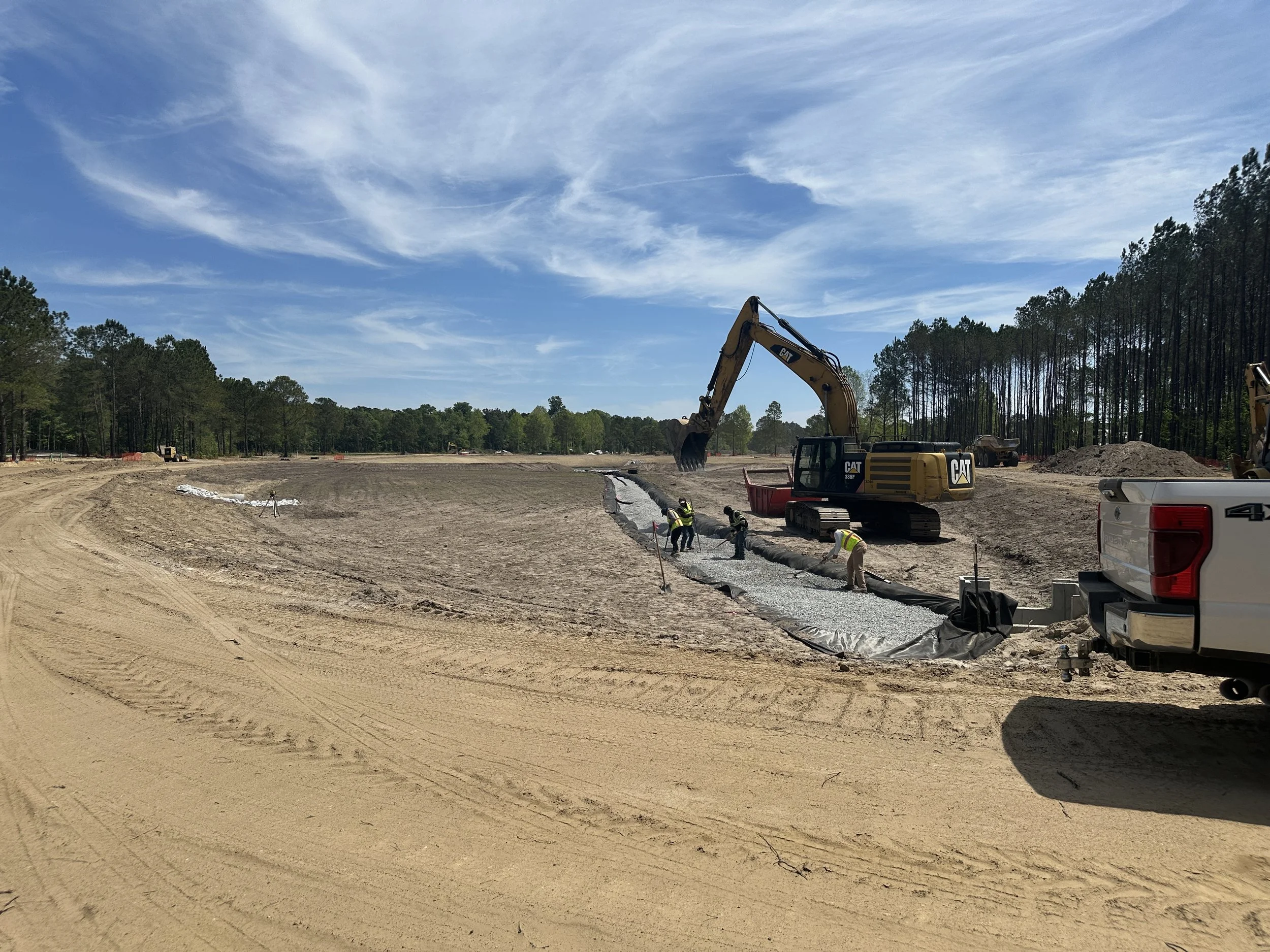
This is the French Drain being put in down the center of the dry pond. We want this to be a nice open park, so designed in a way where most of the overflow from the wet pond will infiltrate immediately and flow down to the outflow without ever being seen. There is a pipe in the middle of all of that rock and water will also be carried through the rock. All of that will be grassed over and you’ll never see it. Only in a major rain event will this park potentially fill up with water.
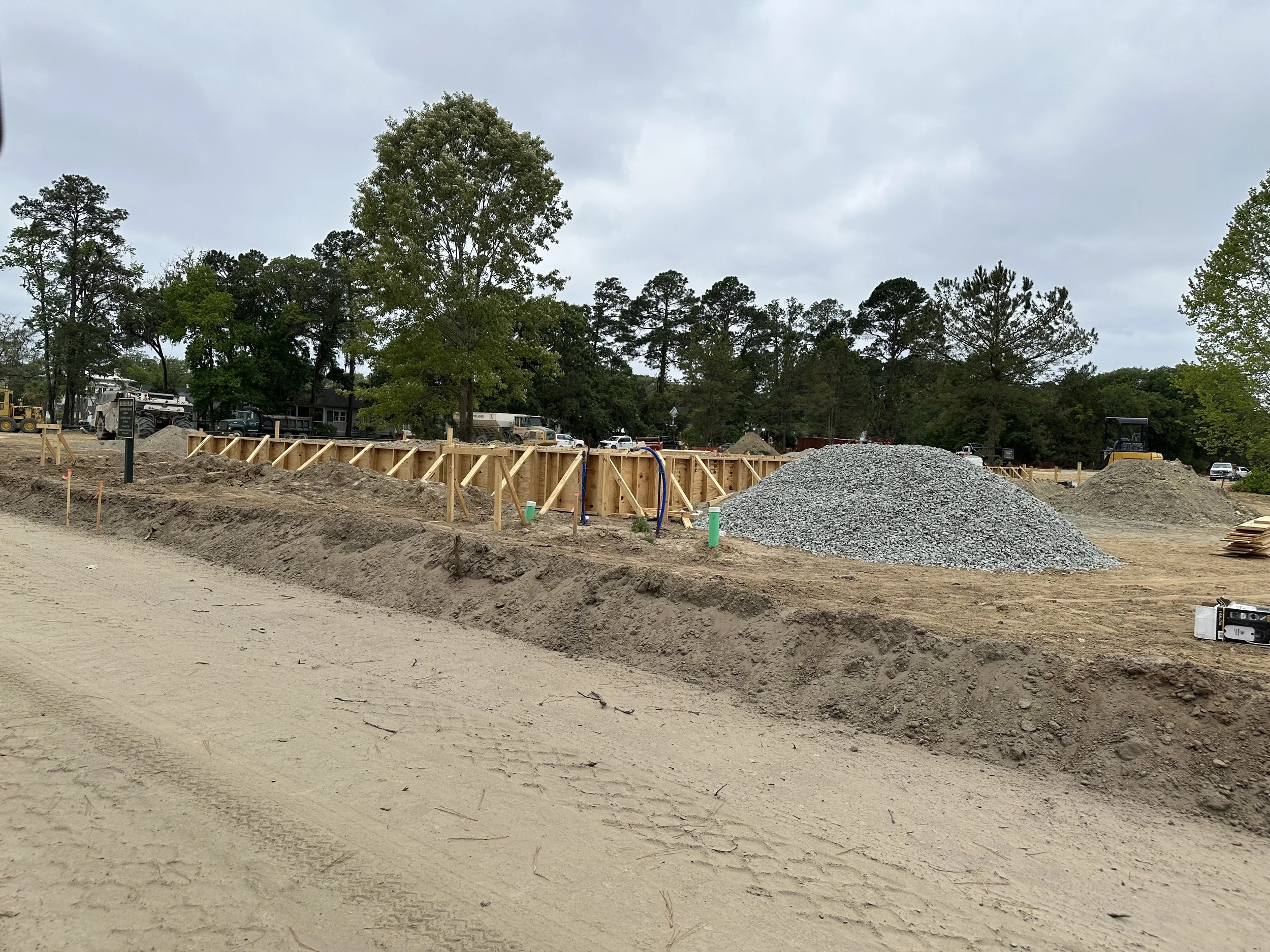
Hey! Look at that! The first house has started! Lanthorne Homes has begun their foundation work, so it won’t be long until we see something vertical coming out of the ground. Other homes should be starting soon.
